




Gender equality and women empowerment
“Gender equality and women empowerment” is the official name of one of the 17 sustainable development goals set for the world to achieve. It is not only about women at work and harassment, one of the most used words in 2019. The 5th sustainable developmental goal includes violence toward women, child marriages, pregnancies, lack of access to education for girls and women, etc. There are initiatives for each of the issues to mitigate. However, we are not on track to make it by 2030, as it was planned in 2015 by the UN (source:https://www.un.org/sustainabledevelopment/gender-equality/).
In this article, I will focus on gender equality at work. My findings are obtained from the survey by EWOB (European women on boards), supported by the Rights, Equality and Citizenship Programme of the European Union (2019, 2021). The report studies 688 European companies from 19 EU countries.
- https://europeanwomenonboards.eu/wp-content/uploads/2020/01/Gender-Equality-Index-Final-report-vDEF-ter.pdf
- https://europeanwomenonboards.eu/wp-content/uploads/2022/01/2021-Gender-Diversity-Index.pdf

There are only 7% of companies in Europe are led by women. Overall, women holding leadership positions are only 30.6% in the EU in large, publicly listed enterprises
And nevertheless, most students in universities are girls.
A study compares 668 large European companies from 19 countries and suggests that the number of companies close to gender equality increased by one-third since 2019-2020. Although, the increase is not equal and steady everywhere.
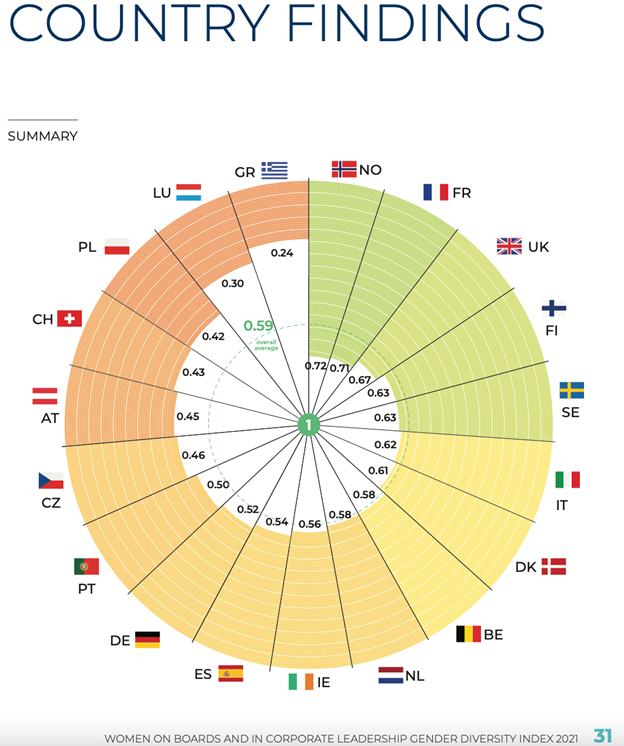
Switzerland, Germany, Poland, and the Czech Republic are the countries where the companies with the smallest gender diversity index (GDI) come from.
Below-average GDI is in Spain and Austria.
A slightly better situation is in France, Norway, Sweden, Italy, Finland, UK, where GDI is average or above average.
In the figures Country findings from the 2021 report, GDI comes in for each country.
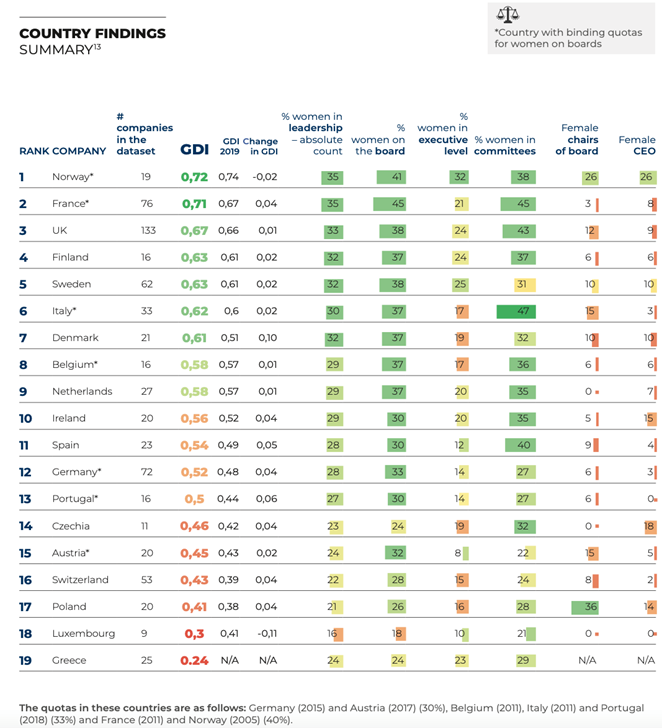
Even when women work in companies, they usually occupy positions at the board level and on board committees. However, their participation in executive layers of corporate decision-making is much lower. C-level or top-executive corporate positions (CEO, COO, CFO) are women-represented by only 25%. Although, compared to 2019, there is an increase of 6% (19% in 2019).
There is a trend that when a woman is CEO/CFO/COO a company tends to hire more women at C-level. GDI score for such corporations is usually above average. But the number of such businesses is still minuscule. Out of all studied companies (688), only 7 have a female CEO and a female CFO/COO (UK, Ireland, the Netherlands, Austria, Denmark).
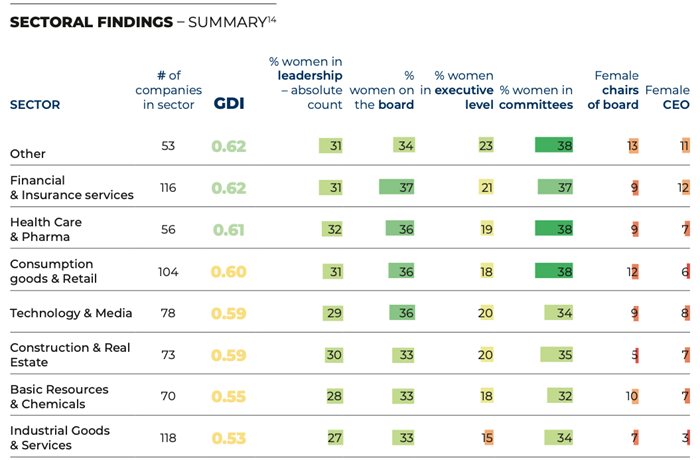
Authors of the reports conclude that the lack of gender equality is a more cultural and national issue than due to the nature of a specific economic sector. But it is possible to name more women-friendly sectors: health care and pharma sectors, the GDI of which rose from 0.55 to 0.61.
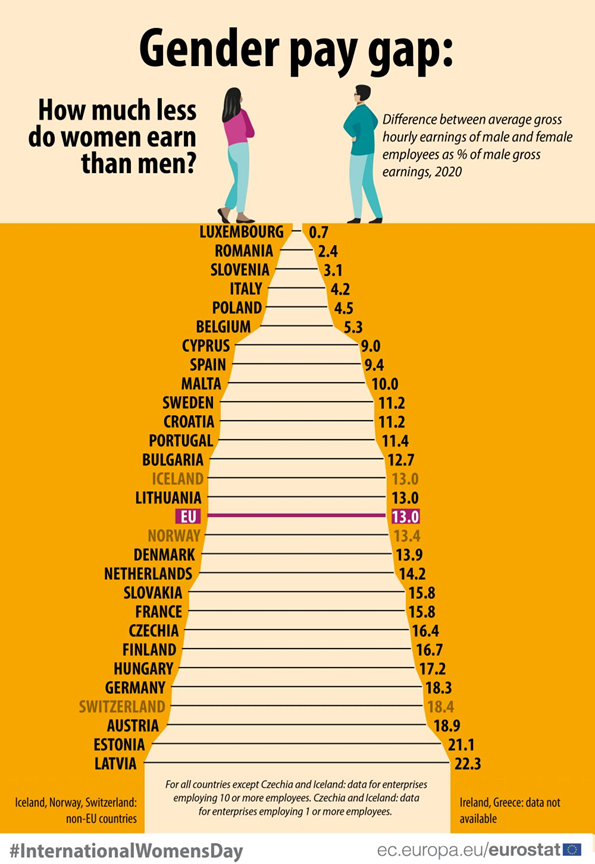
The other problem, women experience unfairly unequal income, even in the same positions. On average, women earn 13% less money than men. 0.87 euro for a woman per every 1 euro earned by a man. It means that to make up the difference, women would have to work 1.5 months more.
Among the reasons for the gender pay gap are sectoral segregation, the glass ceiling, and just the gender discrimination. Some economic sectors that are well women-represented, such as health care and education, are undervalued.
To eliminate the gender pay gap, Europe would need 60 years more (source: https://www.weforum.org/reports/global-gender-gap-report-2022/).
The European Commission has confirmed making income equal and transparent is among the top priorities. One of the actions taken by the European Commission is the European Equal Pay Day happening every November. The day raises awareness about the gender pay gap. The most important effort is to address root causes by monitoring and evaluating the reduction of the unadjusted GPG (gender pay gap). Moreover, in March 2021, a directive on pay transparency was proposed to ensure that women and men in the EU get equal pay for equal work. A list of measures is in place. For instance, employers must provide information about the initial pay level in the job vacancy notice or before the interview. Workers from now on will have the right to request information on their pay level and the average pay levels for men and women and categories of co-workers who do the same work or work of equal value. Moreover, employers with 100+ employees will have to publish information on the GPG.
The directive also provides the basis for compensation for workers who experience gender pay discrimination. Employers will have to prove that there was no discrimination. Moreover, fines will be there for companies that do not pay equally to men and women.
The directive was proposed in 2012, but the European Council blocked the file for almost a decade.
There is also another goal from the authorities in the EU. By 2026 it is planned to increase women’s presence in all large corporates.
- https://ec.europa.eu/eurostat/documents/3888793/13484385/KS-TC-21-004-EN-N.pdf/69965821-22ed-7c56-c859-cd7b10e011c5?t=1633341826751
- https://ec.europa.eu/commission/presscorner/detail/en/ip_22_7739
In the Figure below, you can see how much fewer women earn than men in each country of the EU.
The increase in women’s presence in European countries does exist, but it is slow. With all measures taken in place, there is a chance to accelerate the rate of involving and introducing more talented women into decision-making processes. Hopefully, it will happen faster than the period when women had to be left behind. Recently women’s organizations and movements are getting bigger and louder. It is not a surprise the word of the year 2022 (declared by Dictionary.com) is WOMAN.